
Physiotherapist-Approved Home Workouts: Recovery Meets Fitness
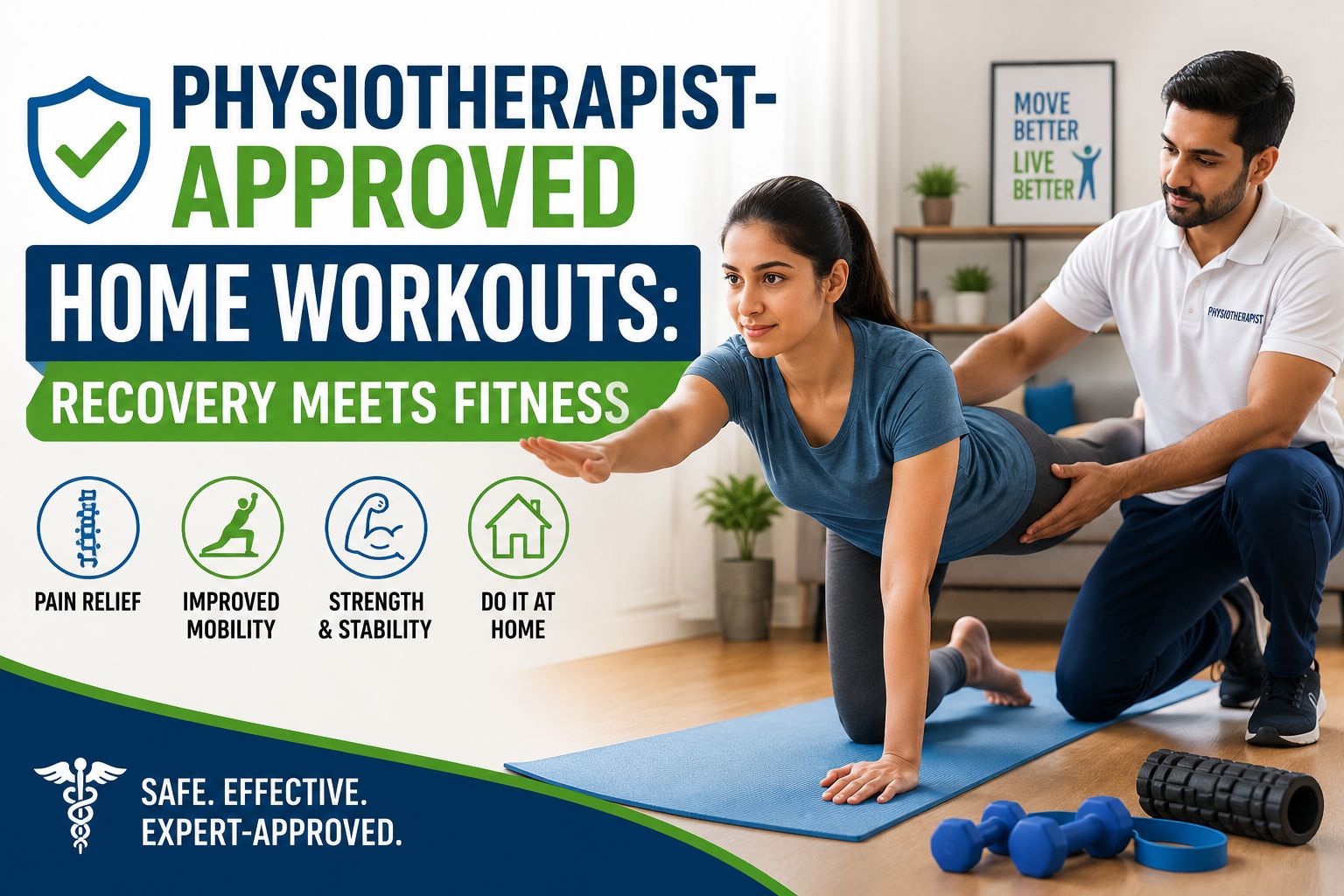
Somewhere between “push through the pain” and “rest until it disappears” lies the smartest approach to getting stronger after an injury, a long illness, or simply months of sitting at a desk. That middle path is exactly what physiotherapist-approved home workouts are built on. They are not watered-down versions of a gym routine, and they are not purely rehabilitative stretching either. They sit at the intersection of two goals that most people assume are separate: healing the body and building it up again. For general health, the WHO physical activity guidelines recommend 150–300 minutes of moderate activity a week plus muscle-strengthening on at least two days — a target a well-planned home programme can help you reach safely.
If you have ever searched for a safe home exercise routine after a knee surgery, a shoulder strain, or lower back pain, you already know how confusing the internet can be. One video tells you to push through discomfort. Another tells you to avoid any movement that causes even mild soreness. A licensed physiotherapist, on the other hand, works from a very different playbook — one based on tissue healing timelines, joint mechanics, and gradual load progression. This article translates that professional playbook into a home-friendly format you can actually follow, without needing a clinic, expensive equipment, or a physiotherapist standing next to you every session.
By the end of this guide, you will understand the principles physiotherapists actually use, sample routines for common problem areas, the equipment worth owning, mistakes that slow recovery, and when it’s time to stop self-managing and book a professional appointment.
Why Physiotherapist Guidance Matters More Than Generic Fitness Advice
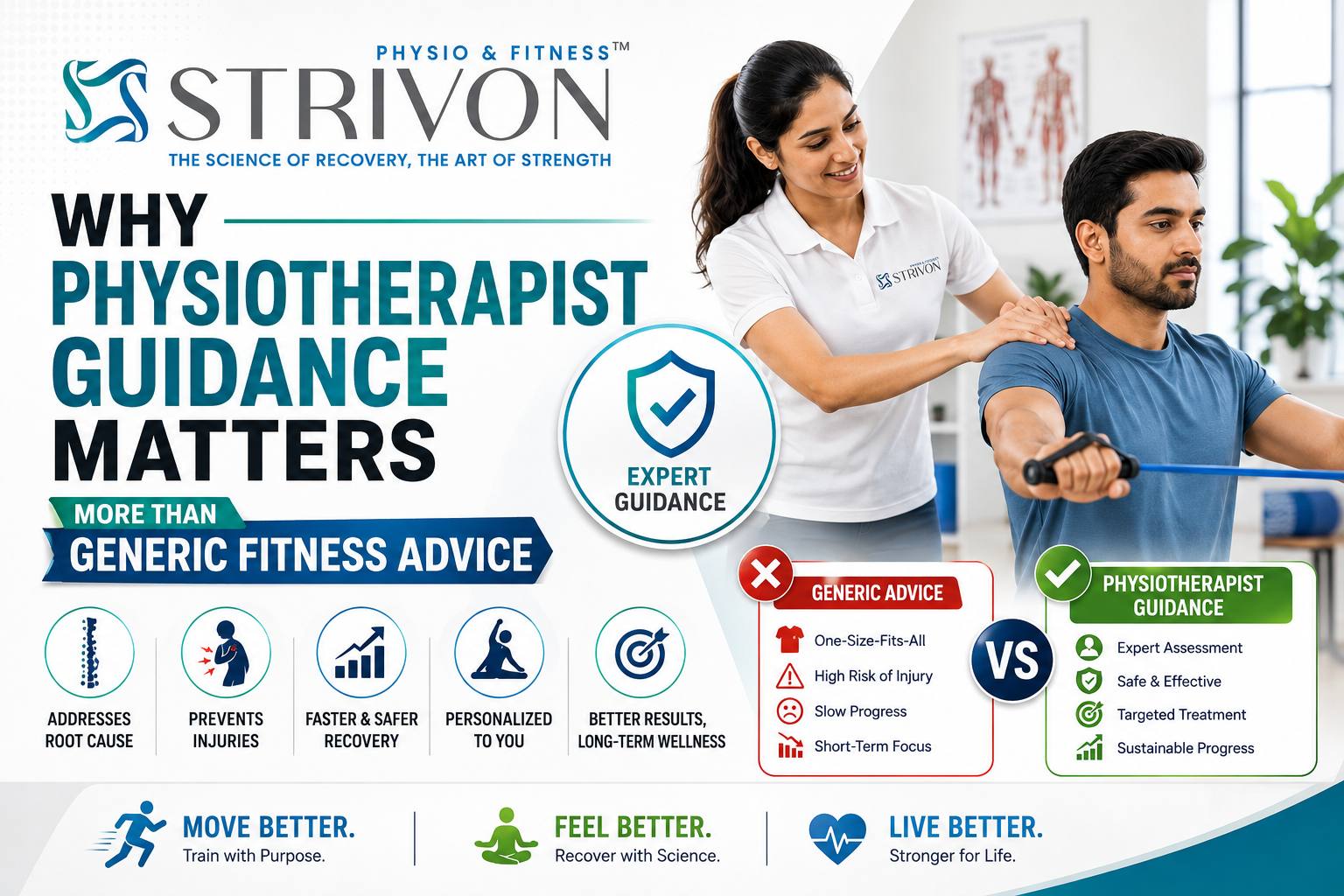
Most fitness content online is written for people who are already healthy and simply want to get fitter. That advice can be genuinely dangerous for someone recovering from an injury, surgery, or a chronic condition like arthritis or a slipped disc. A physiotherapist’s training is different — it centers on understanding how tissue actually heals, how joints load under different movements, and how to build capacity without triggering a flare-up.
This is where physical therapy exercises at home stand apart from typical workout plans. A physiotherapist doesn’t just ask “does this exercise work the muscle?” They ask a longer list of questions: Is the joint stable enough for this range of motion yet? Is the person compensating with another body part? Is the tissue in the inflammatory, proliferative, or remodeling phase of healing? Those questions rarely appear in a standard fitness routine, yet they determine whether an exercise helps or sets someone back by weeks.
There’s also a trust factor. Health content that shapes real decisions about pain, mobility, and injury deserves to be written with genuine expertise, sourced from established rehabilitation science, and free from exaggerated claims. That’s the standard this guide follows — practical, evidence-informed, and honest about what home exercise can and cannot replace.
The Core Principles Behind Every Physiotherapist-Approved Routine
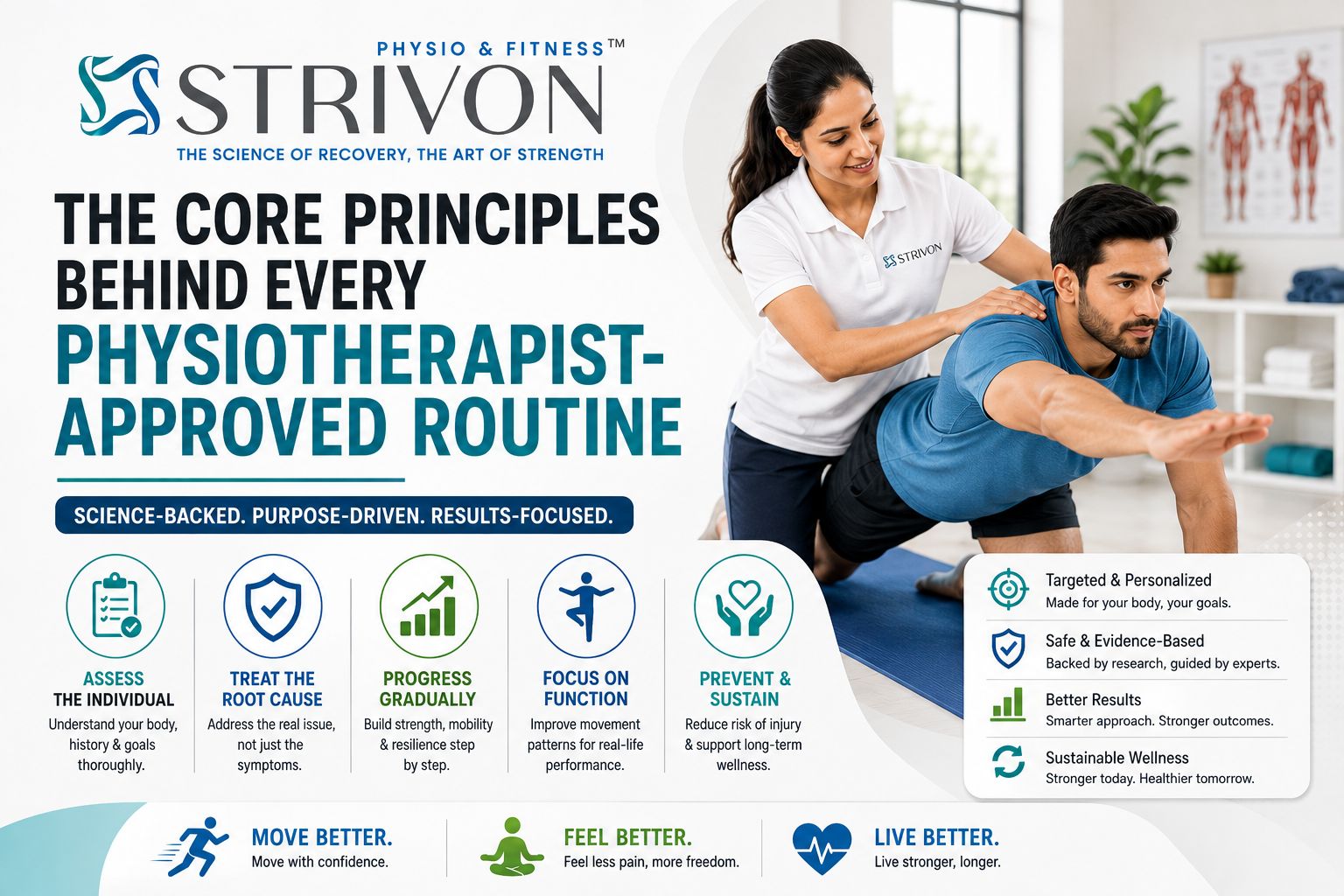
Before jumping into specific movements, it helps to understand the thinking that shapes them. These principles apply whether you’re recovering from a torn ligament or simply trying to move better after months of inactivity.
1. Pain Is Information, Not Just an Obstacle
Physiotherapists commonly use a simple rule: mild discomfort during an exercise is acceptable if it settles within 24 hours and doesn’t get progressively worse. Sharp, shooting, or worsening pain is a stop signal. This nuance is often missing from generic fitness content, where “no pain, no gain” dominates the conversation.
2. Range of Motion Comes Before Strength
A joint that hasn’t regained its full, pain-free range of motion isn’t ready for heavy strengthening work. That’s why injury recovery workouts almost always start with gentle mobility drills before any resistance is introduced. Skipping this step is one of the most common reasons people re-injure themselves.
3. Progressive Overload, Applied Gently
Progressive overload — gradually increasing demand on a muscle or joint — is the backbone of all strength training. In a rehabilitation context, that progression happens in smaller increments: a few extra repetitions, a slightly longer hold, a marginally heavier resistance band, rather than jumping straight to heavier weights.
4. Symmetry and Compensation Checks
When one side of the body is injured, the other side often overcompensates. Physiotherapists watch for this constantly, correcting form so the “good” side doesn’t get overworked while the recovering side stays weak.
5. Consistency Over Intensity
A well-designed home workout recovery exercises program usually asks for shorter, more frequent sessions rather than occasional intense ones. Fifteen focused minutes daily typically outperforms one exhausting hour once a week, both for healing tissue and for building sustainable fitness habits.
The Core Principles Behind Every Physiotherapist-Approved Routine
A well-rounded session generally follows four phases. Skipping any one of them is where most home exercisers go wrong.
Phase 1: Warm-Up (5–7 Minutes)
The goal here isn’t to break a sweat — it’s to increase blood flow to the target area and prepare the nervous system for movement.
- March in place – 1 minute, focusing on lifting knees comfortably
- Arm circles – 20 seconds forward, 20 seconds backward
- Cat-cow stretch – 8–10 slow repetitions to mobilize the spine
- Ankle pumps and circles – especially useful before lower-body work
Phase 2: Mobility and Activation
This phase wakes up the muscles that tend to go “quiet” after injury or prolonged inactivity — the glutes, the deep core stabilizers, and the muscles around the shoulder blades.
- Glute bridges – 2 sets of 10–12, pausing at the top
- Bird-dog – 2 sets of 8 per side, moving slowly and keeping the spine neutral
- Scapular retractions (with or without a light band) – 2 sets of 12
Phase 3: Strength and Functional Movement
This is where fitness and recovery genuinely merge. The movements mimic real-life tasks — sitting, standing, reaching, twisting — while staying within a safe range.
- Sit-to-stand from a chair – 2 sets of 8–10, using arms for support if needed
- Wall push-ups – 2 sets of 10, progressing to countertop push-ups as strength improves
- Step-ups on a low stair – 2 sets of 8 per leg
- Standing row with a resistance band – 2 sets of 12
Phase 4: Cool-Down and Recovery
Ending a session properly reduces stiffness the next day and reinforces the nervous system’s sense of safety around movement.
- Child’s pose – hold for 30–45 seconds
- Seated hamstring stretch – 30 seconds per leg
- Diaphragmatic breathing – 5–6 slow breaths to bring the heart rate down
Sample Routines for Common Recovery Needs
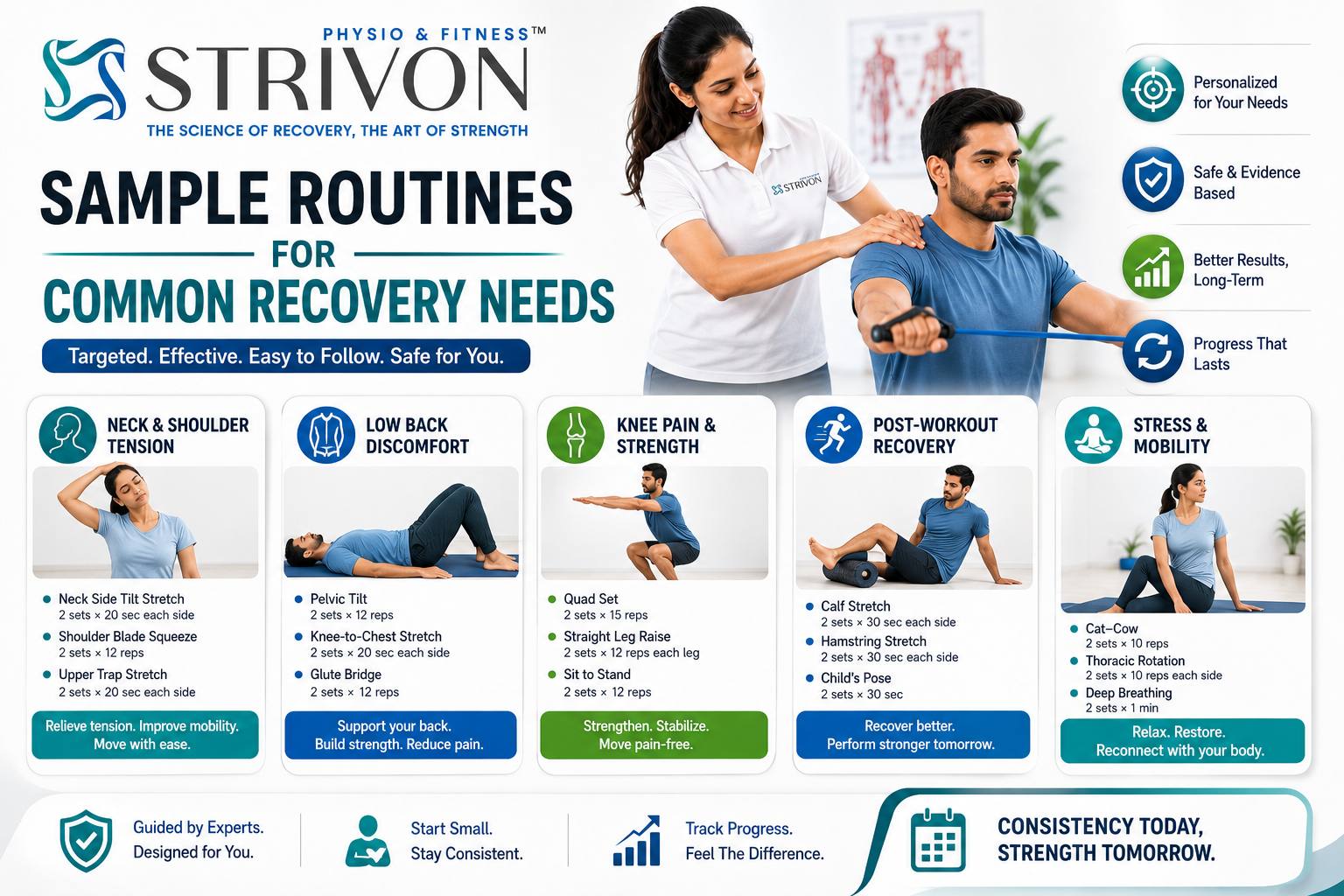
Different injuries call for different emphasis. Below are physiotherapist-informed starting points — always adjusted to your specific diagnosis and cleared by a professional if you’re recovering from surgery or a significant injury.
Lower Back Pain
Lower back discomfort is one of the most common reasons people search for a safe home exercise routine. The focus here is core stability rather than spinal flexion under load.
- Pelvic tilts – 2 sets of 12
- Bird-dog – 2 sets of 8 per side
- Glute bridges – 2 sets of 10
- Knee-to-chest stretch – 30 seconds per side
Knee Rehabilitation
After a knee injury or surgery, quadriceps activation is usually the priority, since this muscle tends to weaken quickly.
- Quad sets (tightening the thigh muscle while the leg is straight) – 3 sets of 10, holding 5 seconds
- Straight leg raises – 2 sets of 10
- Mini squats to a chair – 2 sets of 8
- Heel slides – 2 sets of 10
Shoulder Recovery
Shoulders need range of motion restored gradually before any loaded movement begins.
- Pendulum swings – 1 minute
- Wall walks (fingers walking up a wall) – 2 sets of 8
- External rotation with a light band – 2 sets of 12
- Doorway chest stretch – 30 seconds
General Fitness After a Sedentary Period
For those without a specific injury but returning to movement after months of inactivity, the emphasis shifts toward building baseline cardiovascular and muscular capacity.
- Marching in place – 3 minutes
- Sit-to-stands – 2 sets of 10
- Wall push-ups – 2 sets of 10
- Standing marches with arm swings – 2 minutes
Equipment Worth Having (None of It Expensive)
One reassuring truth about physical therapy exercises at home is that they rarely require a home gym. A physiotherapist’s toolkit for home use is refreshingly minimal:
- A set of light resistance bands (loop and tube style)
- A stable chair without wheels
- A yoga mat for floor-based work
- A small step or sturdy stair for step-ups
- Optional: a foam roller for muscle tension relief
Spending on elaborate machines is rarely necessary during the recovery phase. In fact, most physiotherapists recommend mastering bodyweight control before introducing external resistance at all.
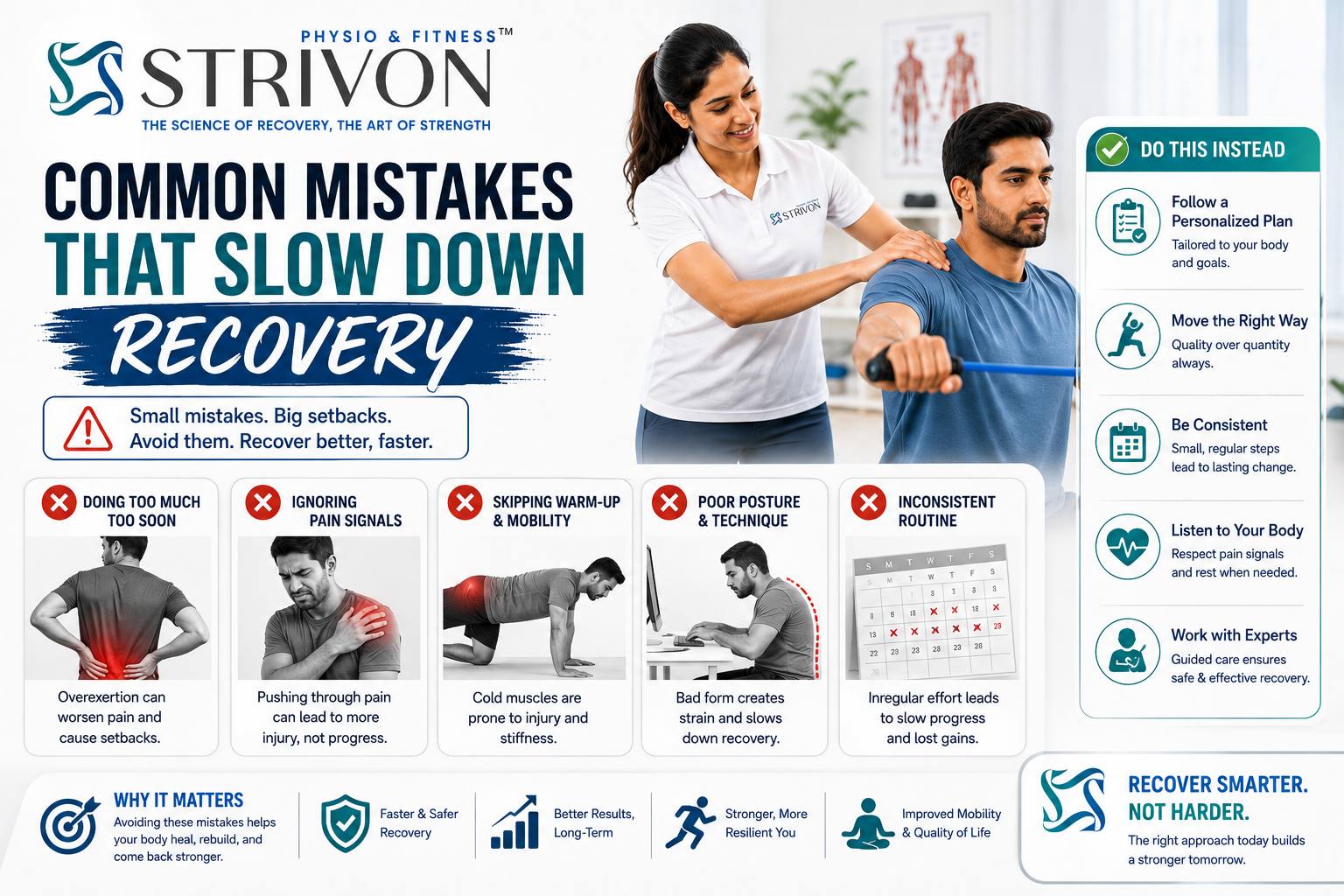
Common Mistakes That Slow Down Recovery
Even well-intentioned home exercisers make errors that a clinical eye would catch immediately. Watch for these:
Doing too much, too soon. Feeling good on day three doesn’t mean the tissue has fully adapted. Overzealous progression is one of the leading causes of setback.
Ignoring form for the sake of repetitions. Ten sloppy squats are worse than five controlled ones. Quality of movement matters more than quantity, especially early in recovery.
Skipping the warm-up. Jumping straight into strength work without preparing the joints increases strain and reduces the benefit of the session.
Comparing recovery timelines to someone else’s. Healing speed depends on age, injury severity, overall health, and consistency — not willpower alone.
Avoiding movement out of fear. Excessive caution can be just as harmful as overdoing it. Gentle, guided movement generally speeds healing more than complete rest, except in the earliest inflammatory stage.
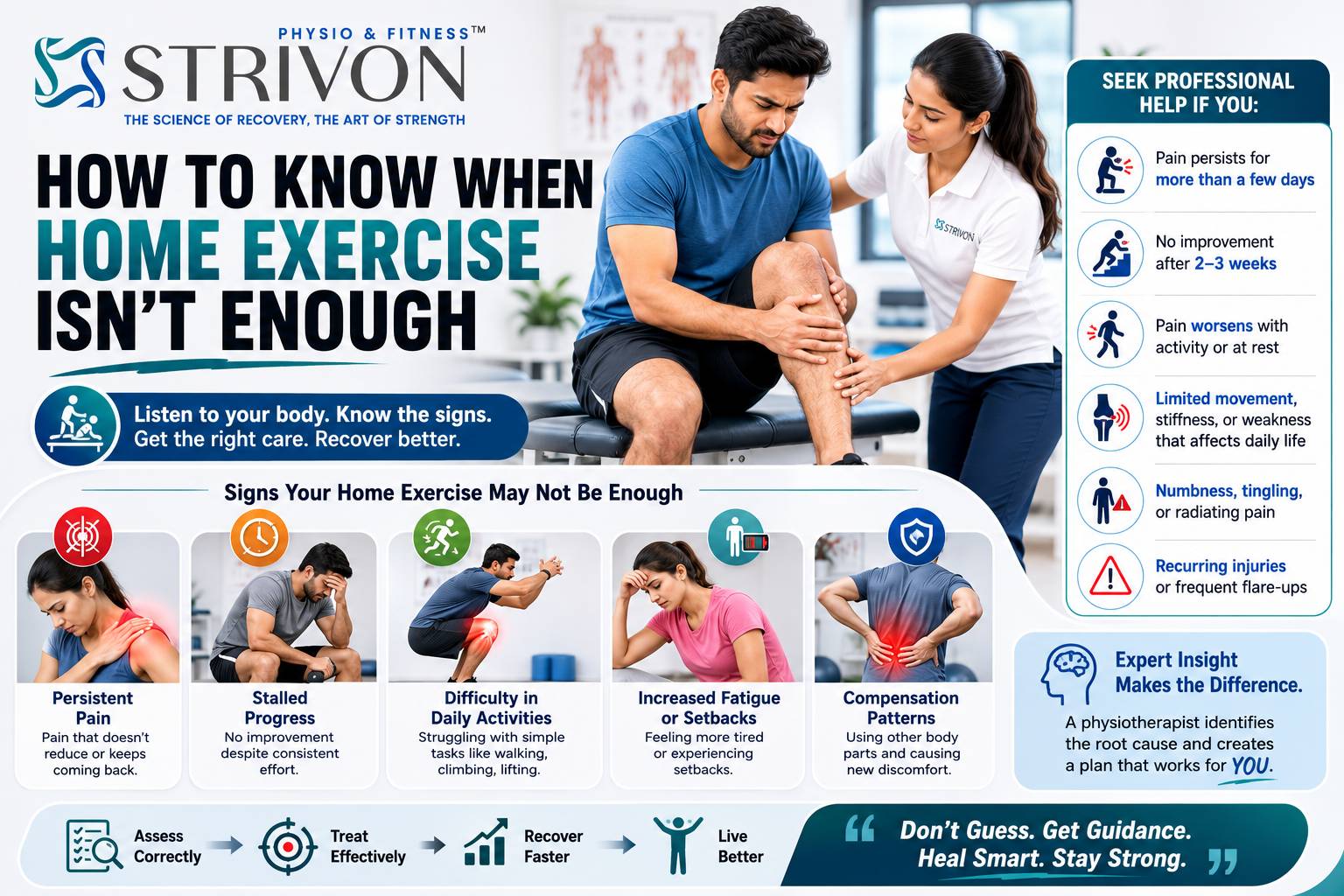
How to Know When Home Exercise Isn't Enough
Home routines are genuinely effective for many mild-to-moderate conditions, but certain signs mean it’s time to consult a licensed physiotherapist in person rather than continuing solo:
- Pain that worsens over several sessions instead of improving
- Numbness, tingling, or weakness that wasn’t present before
- Swelling that doesn’t reduce with rest and gentle movement
- Difficulty bearing weight on a limb
- A recent surgery without a formal rehabilitation plan yet in place
A physiotherapist can assess movement patterns, joint mechanics, and healing stage far more precisely than any general home program, adjusting your plan in real time based on how your body actually responds.
FAQ
Most conditions respond well to 4–6 sessions per week of 15–30 minutes, though frequency should match your specific injury and energy levels. Consistency matters more than duration.
For maintenance and mild issues, often yes. For post-surgical recovery, severe injuries, or complex conditions, home exercise works best alongside — not instead of — professional guidance.
Mild soreness that fades within a day is generally normal. Sharp pain, swelling that increases, or soreness lasting several days is a signal to scale back and consult a professional.
Recovery-focused exercises prioritize controlled range of motion, symmetry, and gradual loading tied to tissue healing stages, while general fitness exercises assume a healthy, fully functional body from the start.
No. A chair, a mat, and a light resistance band cover the vast majority of physiotherapist-approved home routines.