Runner’s Knee (Patellofemoral Pain)
Ache around or behind the kneecap, worse on stairs, squatting or after sitting for long. Very common in runners, gym-goers and teenagers who play a lot of sport.

 Knee Pain Treatment
Pain on the stairs, a knee that swells after cricket, stiffness every morning or a surgery you want to avoid — we find out why your knee hurts and rebuild it with a clear, measurable plan.
Short answer: for most knee pain, yes. Runner’s knee, early knee osteoarthritis, patellar tendon pain, ligament sprains and meniscus irritation usually improve with a structured programme of strengthening, movement correction and load management over 6 to 12 weeks. Knee pain physiotherapy in Ahmedabad at Strivon starts with a 60-minute assessment, so you know the cause, the plan and a realistic timeline in the first session.
Most knees do not hurt because something is “worn out”. They hurt because the load going through the joint is higher than what the thigh, hip and calf muscles can currently absorb. Rest brings the pain down for a while, but it also weakens those muscles, so the pain returns the moment you walk more, climb stairs or go back to sport.
Good knee pain treatment in Ahmedabad therefore does two jobs: it calms the irritated tissue quickly, and then it rebuilds capacity so the knee can handle your real life — long days at work, temple steps, a Sunday cricket match or garba nights.
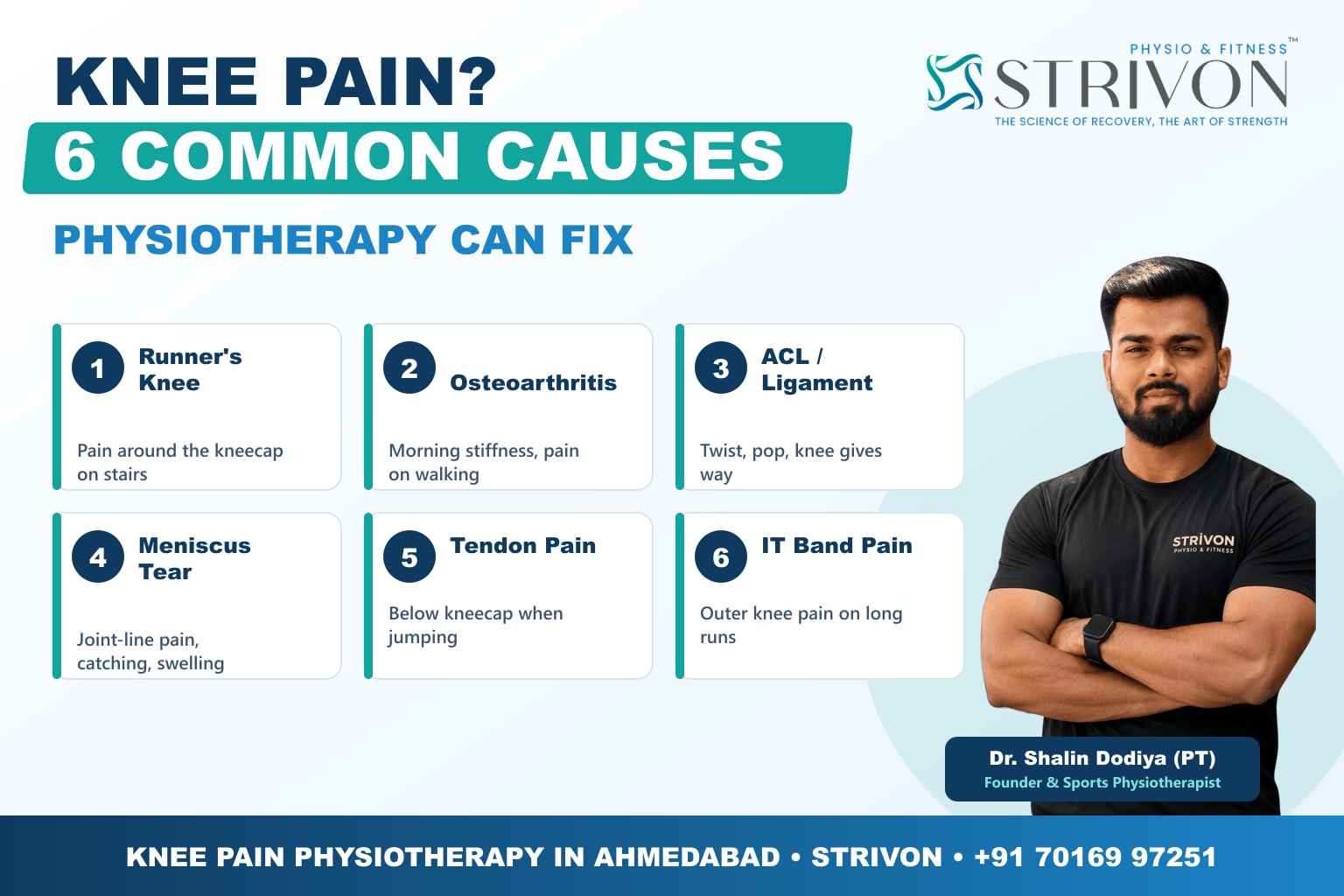
These six problems make up most of the knee pain physiotherapy in Ahmedabad we do. Where the pain sits and when it hurts usually tells us which structure is involved.
Ache around or behind the kneecap, worse on stairs, squatting or after sitting for long. Very common in runners, gym-goers and teenagers who play a lot of sport.
Morning stiffness, pain after walking and a feeling of grinding, usually after 45. Exercise-based physiotherapy is the first-line treatment in international guidelines.
A twist while landing or turning, a pop, swelling and a knee that gives way. Whether or not you need surgery, rehabilitation decides how well you come back.
Pain on the inner or outer joint line, catching or swelling after squatting or twisting. Many degenerative tears settle well with targeted loading.
Pain just below the kneecap when jumping, climbing or kneeling — “jumper’s knee”. Tendons need progressive load, not only rest and ice.
Sharp pain on the outside of the knee during longer runs or cycling, usually linked to hip strength and sudden jumps in training volume.
History, swelling and range checks, ligament and meniscus tests, and strength testing of the quadriceps, hamstrings, hip and calf. We also watch you squat, step down and, if relevant, run or hop.
Hands-on treatment, taping, activity changes and pain-free isometric exercises so you can walk, sleep and work more comfortably while the knee settles.
Progressive strengthening for the thigh, hip and calf — the muscles that actually protect the knee. Exercises get harder only when your numbers improve.
Stairs, squats, landing, running and turning are rebuilt with good control, so the load is shared by the right muscles instead of the painful joint.
Strength and hop symmetry testing before you return to full sport, plus a short home plan to keep the knee strong after discharge.
Knee pain physiotherapy in Ahmedabad at Strivon is for everyone from school cricketers to grandparents who want to walk to the temple again. If you have already tried medicines, injections or another clinic’s programme, bring your reports — knowing what did not work helps us.
Tell us your situation and we will confirm your assessment slot on WhatsApp and email.
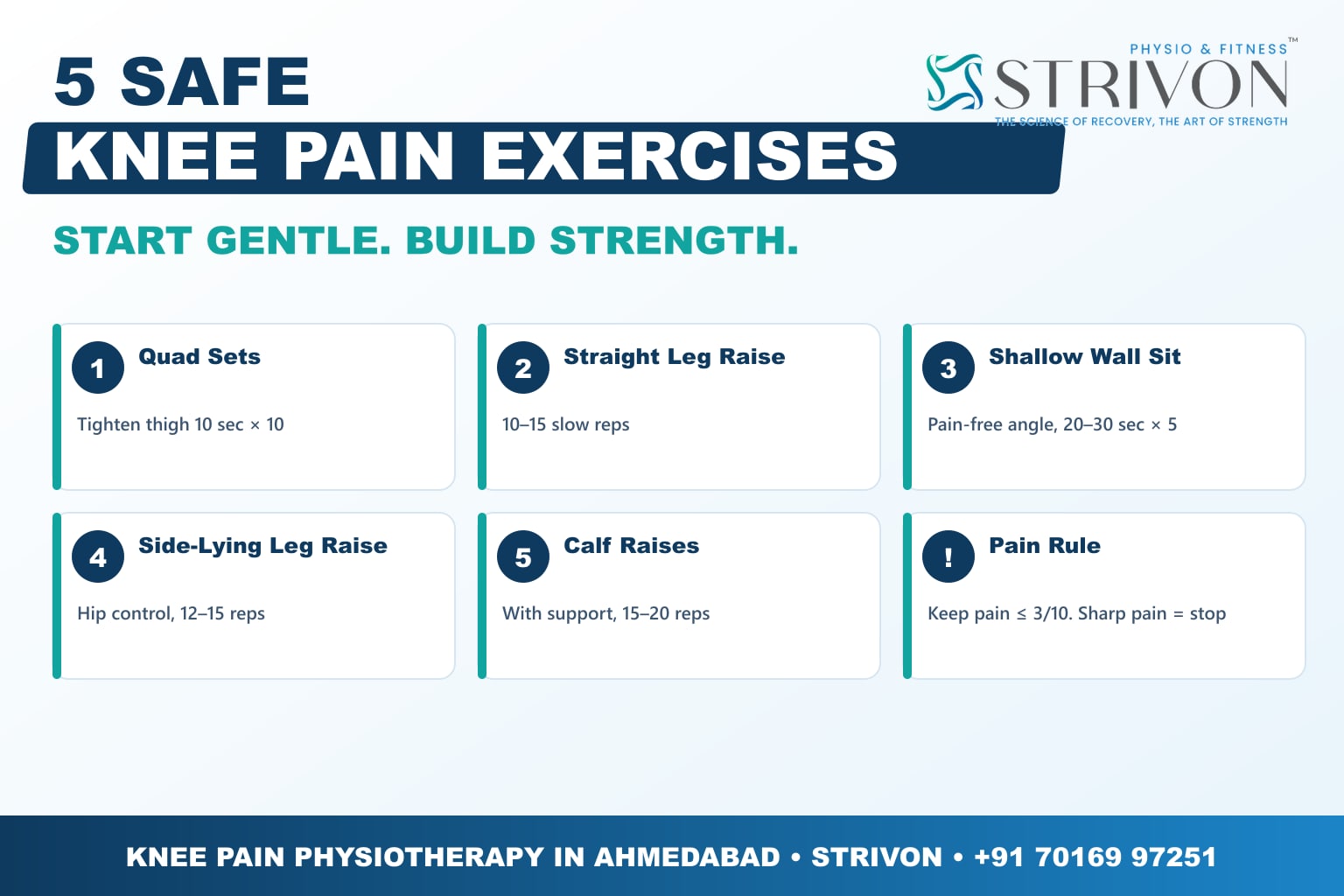
These are the gentle starting exercises we give most people who come to us for knee pain physiotherapy in Ahmedabad. Do them slowly, 1 to 2 times a day. Mild discomfort up to 3 out of 10 is acceptable; sharp or increasing pain is not — stop and get assessed.
For a full plan matched to your knee, see our guide to physiotherapist-approved home workouts or book an assessment.
Most knee pain treatment stops at machines and a sheet of exercises. At Strivon, physiotherapy for knee pain is a measured strength programme: we test your thigh and hip strength, set targets, and progress you until the painful knee performs like the healthy one.
Because rehab and a strength floor sit under one roof in Ambavadi, your gym work starts in week one under the same team — not after discharge.
Typical ranges for knee pain physiotherapy in Ahmedabad when patients follow their plan — not promises. Your age, activity level and how long the pain has been there all change the picture.
| Knee condition | Typical improvement window | What we measure before discharge |
|---|---|---|
| Runner’s knee (patellofemoral pain) | 6–12 weeks | Pain-free stairs and squats, hip and quad strength |
| Knee osteoarthritis (early to moderate) | 8–12 weeks for a clear change | Walking distance, sit-to-stand test, quad strength |
| Patellar tendinopathy | 12–24 weeks | Pain-free single-leg decline squat and hops |
| Meniscus tear (non-surgical) | 6–12 weeks | Swelling-free loading, full range, strength symmetry |
| ACL reconstruction | 9–12 months | Limb symmetry index above 90% across hop tests |
| Total knee replacement | 3–6 months | Knee bend beyond 110°, independent stairs |
Exercise therapy as first-line care for knee osteoarthritis follows the NICE osteoarthritis guideline. Your individual plan is confirmed after assessment.
If any of these apply, we will guide you to the right specialist the same day before starting physiotherapy.
Serving Ahmedabad & Gujarat
We provide knee pain physiotherapy in Ahmedabad from our clinic at Parimal Cross Road, Ambavadi, close to Paldi, Navrangpura, Ellisbridge, Vasna and Satellite. Patients also travel from Bopal, Thaltej, Prahlad Nagar, Vastrapur, Maninagar, Gota and Gandhinagar, and people elsewhere in Gujarat use our online physiotherapy consultation. Call or WhatsApp +91 70169 97251 to check availability.
For most knee pain, yes. Runner's knee, early to moderate osteoarthritis, tendon pain and many meniscus tears improve with a structured strengthening and movement programme. Surgery is usually needed only for a knee that keeps giving way after a ligament tear, a locked knee, or advanced arthritis that has not responded to good rehabilitation.
Most people need 6 to 12 sessions spread over 6 to 12 weeks, with exercises at home between visits. Simple runner's knee may settle faster; tendon problems and post-surgery rehabilitation take longer. After your first assessment we give you a realistic range rather than a fixed package.
No. Complete rest weakens the thigh and hip muscles that protect the knee, so the pain often returns when you become active again. Reduce the activities that clearly flare it up, but keep moving within a comfortable range and start gentle strengthening early.
For osteoarthritis and most non-injury knee pain, walking at a comfortable pace is helpful. Keep the pain during and after the walk at or below 3 out of 10 and build the distance gradually. After a fresh injury with swelling, get the knee assessed before walking long distances.
Usually not. A careful clinical examination identifies most knee problems. We recommend an MRI when we suspect a significant ligament or meniscus tear that may need surgery, or when the knee is not improving as expected.
Yes. For seniors and patients after knee replacement or ACL surgery, a Strivon physiotherapist can visit your home in Ahmedabad with portable equipment. We usually recommend at least one clinic visit for full strength testing when possible.
Physiotherapy sessions in Ahmedabad commonly range from about 500 to 1,500 rupees per session in clinics, with home visits costing more. Strivon quotes the exact fee for your plan before you book, with no hidden session packages. Message us on WhatsApp at +91 70169 97251 for current rates.
Start knee pain physiotherapy in Ahmedabad with a 60-minute assessment and leave knowing the cause of your pain, your timeline and your first two weeks of exercises.