
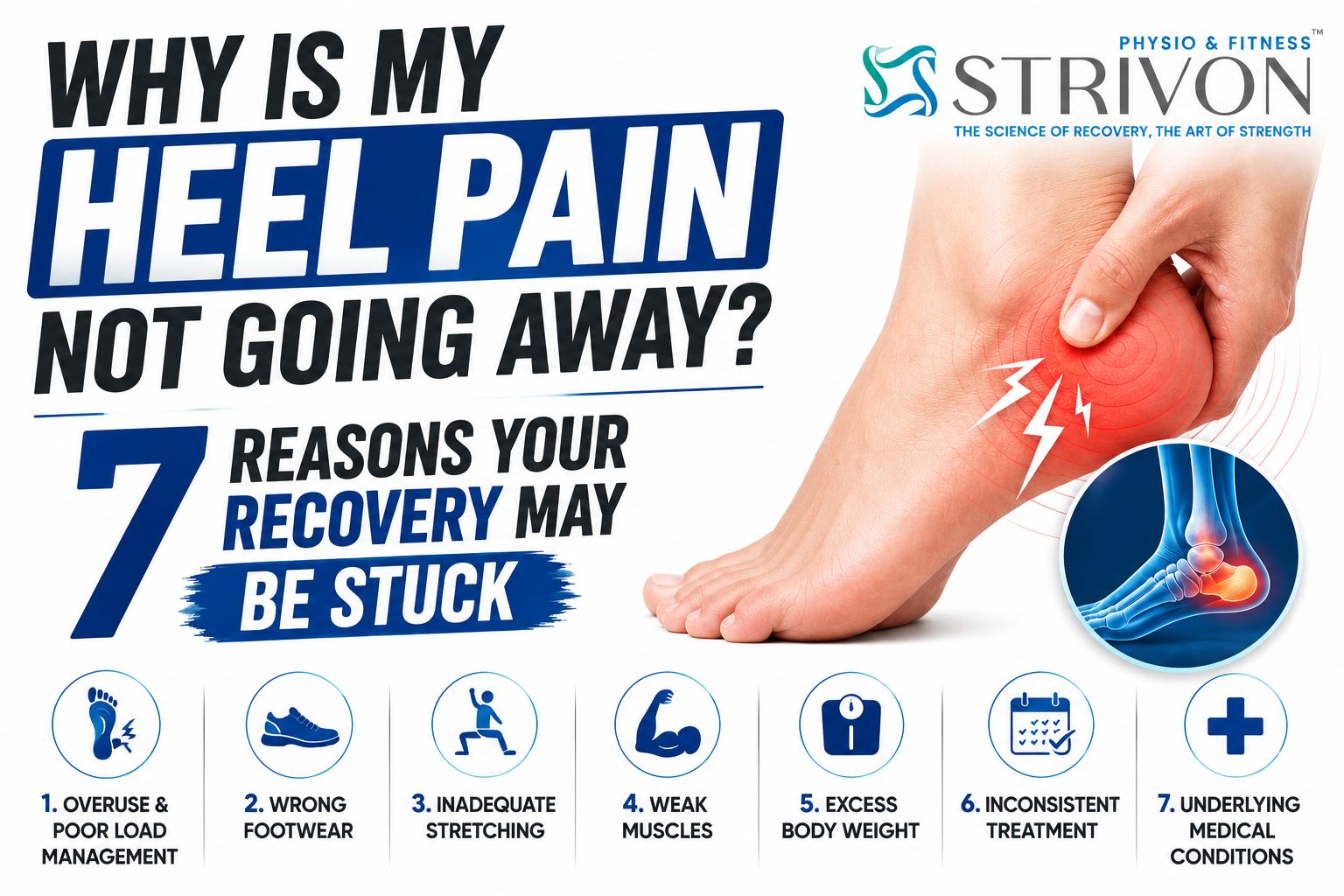
Why Is My Heel Pain Not Going Away? 7 Reasons Your Recovery May Be Stuck
You’ve stretched. You’ve rested. You’ve swapped your shoes, rolled your foot on a frozen bottle, bought the insoles, and maybe even had a cortisone injection. Yet those first steps out of bed still bite, and by the end of a long day your heel is throbbing again. If your heel pain not going away has started to feel like your new normal, you are not imagining it — and you are not failing at recovery as a person. Far more often, a case of chronic heel pain stays stuck because the strategy is incomplete, not because your body cannot heal.
Chronic heel pain is one of the most common complaints physiotherapists see, and one of the most frustrating to live with, precisely because so many “sensible” treatments only fix half the problem. This article walks through the seven reasons persistent heel pain most often refuses to resolve — so you can identify what is really holding your recovery back, and change it.
Quick answer: why chronic heel pain persists
Chronic heel pain usually persists for one of seven reasons: the wrong diagnosis, load capacity that was never rebuilt after rest, calf and foot muscles too weak for your daily demands, activity that repeatedly outpaces your current tolerance, treating the heel in isolation, relying only on passive symptom relief, or a rehabilitation plan that was never progressed. Resolving chronic heel pain means restoring strength, load tolerance and function — not simply chasing a lower pain score. Get the cause right and progress the plan, and most stubborn cases finally begin to move.
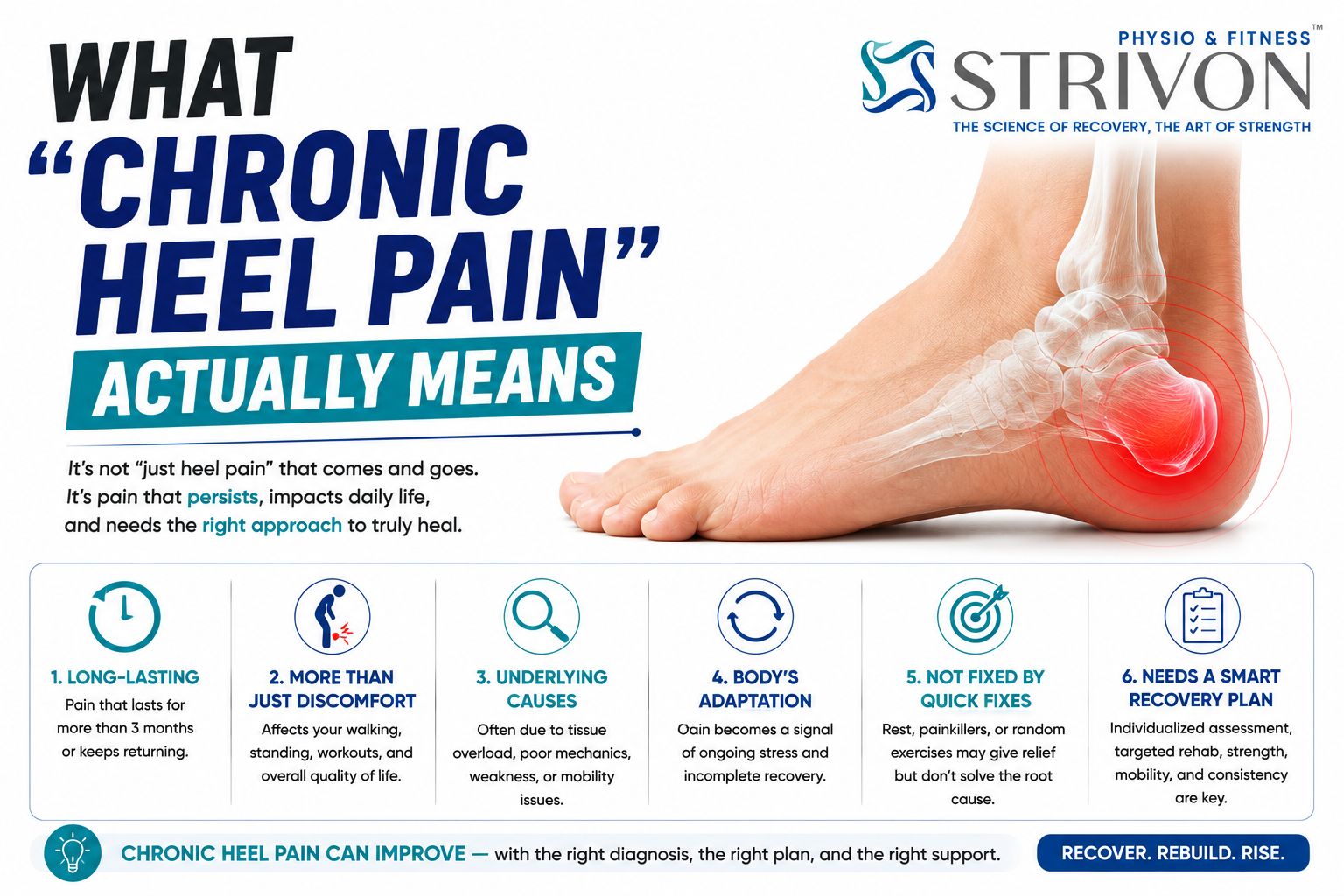
What "chronic heel pain" actually means
Heel pain is called chronic — or persistent — once it has lasted beyond roughly three months. It is remarkably common: heel pain affects up to one in ten adults at some point, and the single most frequent driver is plantar fasciitis, an irritation of the thick band of tissue (the plantar fascia) running along the sole of your foot from the heel to the toes.
Here is the crucial part. “Plantar fasciitis” has quietly become a catch-all label pinned on almost any sore heel, and that loose labelling is exactly where many stalled recoveries begin. Chronic heel pain is a signpost, not a full diagnosis. The good news: chronic heel pain is highly treatable once the plan finally matches the true cause — but that means understanding what is really happening beneath the symptom, not treating the word on a leaflet. For a reliable overview of the most common cause, the NHS guide to plantar fasciitis is a solid place to start.
The two stages of recovery almost everyone misses
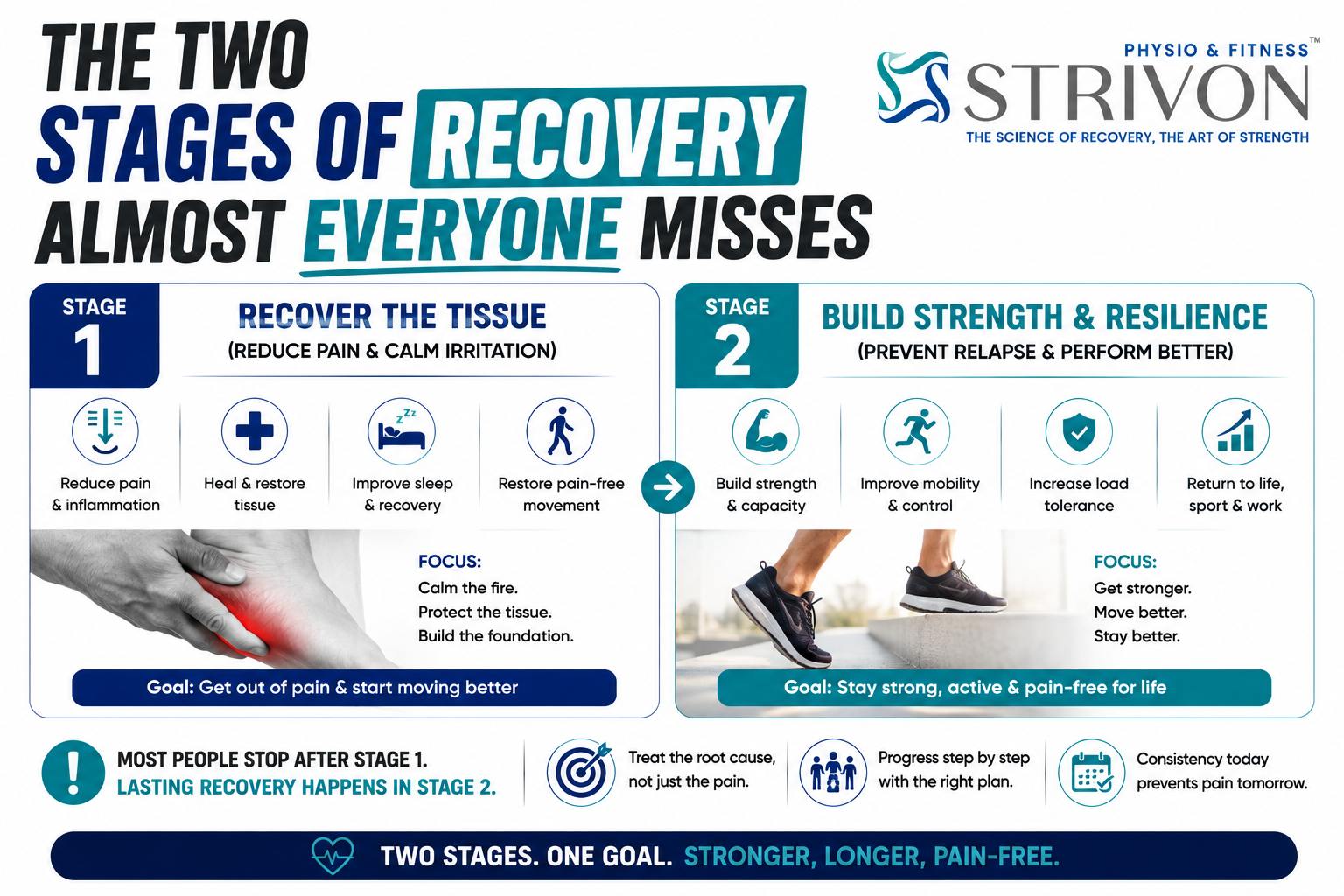
One idea explains most of the reasons below. Recovery from chronic heel pain has two stages, and most people only finish the first. Stage one is calming the symptoms — settling the pain and irritation so the heel is no longer angry. Stage two is rebuilding capacity — increasing the tissue’s ability to tolerate load so it can handle walking, standing, running and life without flaring again. Pain reduction and tissue tolerance are genuinely different things.
The trap is simple: symptoms often settle in stage one, so it feels like you have recovered, and the harder work of stage two never happens. Then real life returns, demand climbs, and the pain comes straight back — because nothing was ever built. Almost every reason for chronic heel pain below is a version of this.
1. The real cause hasn't been identified
Not every sore heel is plantar fasciitis. Chronic heel pain can also come from a bruised or thinning heel fat pad, an Achilles tendon problem where the tendon meets the heel bone, a stress reaction inside the heel bone, nerve entrapment (such as Baxter’s nerve), heel bursitis, or pain referred from the lower back. Each has a different mechanism — and each needs a different plan.
This is the single biggest reason chronic heel pain drags on: the treatment is well executed, but it is solving the wrong problem. Fascia-specific loading is excellent for plantar fasciitis and close to useless for a heel-bone stress reaction, which actually needs offloading. If weeks of a plantar-fasciitis-style plan haven’t shifted your symptoms, the useful question is not “which exercise next?” — it is “am I even treating the right thing?”
A proper physiotherapy assessment turns a guess into a target. It should reproduce your specific pain, test the surrounding structures one by one, screen for red flags that point to bone or nerve causes — the same differentials set out in the JOSPT clinical practice guidelines for heel pain — and take a genuine history of how the problem began. Without that, you are simply hoping the label is correct — and with chronic heel pain, it often isn’t.
2. You reduced activity — but never rebuilt capacity
Rest feels like the obvious answer, and early on it can be right — backing off an irritated heel lets it settle. But that is stage one, and stopping there is why so much chronic heel pain returns the moment life speeds back up.
Think in terms of demand and capacity. Rest lowers the demand on the tissue. It does nothing to raise the tissue’s capacity to handle demand — in fact, prolonged rest reduces capacity, because tissue weakens when it isn’t challenged. So the pain quietens while you do less, then flares as soon as you walk further, work a full shift, or run again, because the heel is no better able to cope than before. Recovering from chronic heel pain is not only “calm it down”; it is “build it back up” so the tissue tolerates the loads your life demands. Rest buys a window — what you do inside that window decides whether persistent heel pain resolves or returns.
3. Your calf and foot aren't strong enough for your daily demands
Every step sends force through your foot, plantar fascia, Achilles and calf. When those structures are strong, they absorb and redistribute that force. When they are weak, the force has nowhere to go but into the painful heel, thousands of times a day. This is one of the most overlooked engines of chronic heel pain.
Walking, prolonged standing, running and sport all demand real, trainable strength — from the big calf muscles down to the small intrinsic muscles that support your arch. If your rehab so far has been all foam-rolling, massage and gentle stretches with no meaningful loading, your foot may simply be under-built for your day. Stretching can feel nice and ease symptoms briefly, but it does not build capacity.
Progressive strengthening — not stretching alone — is increasingly recognised as a key driver of lasting recovery from plantar heel pain (peer-reviewed rehabilitation case report). In practice that means heavy, slow calf raises progressed over weeks (often with the toes propped to load the fascia), single-leg work, and foot-muscle exercises. Done properly, this loading is frequently the missing ingredient in heel pain treatment — the difference between temporary relief and a heel that can finally handle your life.
4. Your training or daily load keeps exceeding your current capacity
Recovery stalls when what you repeatedly ask of the heel keeps overshooting what it can currently handle. Clinicians call this the “load-versus-capacity” gap, and it explains a huge share of chronic heel pain that seems to flare “for no reason.”
The trigger is almost always a change in the rate of loading. A jump in weekly running distance. A new job on your feet. A holiday of long walks on hard pavements. A switch from cushioned shoes to flat ones. Ramping training back too fast after a break. None of these are “bad” — they are simply faster than your tissue has adapted to handle. Tissue can get stronger, but adaptation takes time, and when demand climbs faster than capacity, the gap between them is where chronic heel pain lives.
Managing chronic heel pain therefore means managing the rate of change. That is not the same as doing nothing. It means increasing walking, standing, training volume and impact gradually and deliberately, so capacity rises alongside demand instead of being repeatedly overwhelmed. Track this honestly and the “random” flare-ups usually turn out to have a very clear cause.
5. You're treating the painful area in isolation
The heel rarely acts alone. How far your big toe extends, how well your ankle bends, how your calf absorbs load, how your hip and knee control each stride — all of it changes the force that finally reaches your heel. Treat the sore spot in isolation and you may keep re-loading it the same flawed way, no matter how diligent you are.
Take stiff ankle motion as an example. If your ankle cannot bend far enough, your foot compensates by rolling and flattening more than it should, dragging on the plantar fascia with every step. No amount of local heel treatment fixes that; restoring the ankle motion does. The same logic runs up the chain — weak hip control, a stiff big toe, or how you push off can all quietly overload the fascia.
Genuine progress with chronic heel pain often comes from zooming out to the whole lower limb: restoring ankle mobility, improving how you load and push off, fixing footwear that works against you, and correcting movement habits that keep feeding the problem. If your plan has never looked above the ankle, that missing link may be exactly why chronic heel pain keeps circling back.
6. You're relying only on passive treatment
Massage, taping, ice, ultrasound, dry needling, shockwave, orthotics and cortisone injections all have a place. They can take the edge off a painful heel and open a window in which loading suddenly feels possible. Used that way, they are useful. But there is a catch worth naming: these are all things done to you, and on their own, passive treatments rarely build the lasting capacity that ends chronic heel pain.
Watch for relief that lasts hours or a few days and then fades — so you keep going back for the next treatment, the next tape job, the next injection, without ever quite getting better. That cycle is a strong clue that symptom relief has quietly replaced rehabilitation. Injections and orthotics in particular can mask pain so well that the underlying weakness is never addressed, which is why the relief proves temporary.
The most effective heel pain treatment uses passive tools as a support act for the main event — progressive, active loading that changes the tissue itself. If everything on your plan is passive and nothing is progressive, that imbalance alone can keep chronic heel pain going indefinitely.
7. You haven't progressed your rehabilitation
Even the right exercises stop working if they never get harder. Tissue adapts specifically to the load you place on it; give it the same load month after month and adaptation plateaus — and so does your recovery. A surprising amount of “stubborn” chronic heel pain is really un-progressed rehab: the same three exercises, at the same reps, at the same easy intensity, long after the body stopped finding them a challenge.
Effective rehabilitation is progressive by design. Over the weeks it should gradually increase resistance, repetitions, tempo, range, standing time and — eventually — impact, so your foot and calf are continually asked to do a little more than last week. That is how capacity is built. Skip the progression and you are maintaining, not recovering.
Just as important is the right measure of success. The goal is not simply “less pain.” It is restoring strength, function and tolerance to the activities that matter to you — walking without limping afterwards, standing through a full shift, chasing your kids, returning to sport. When chronic heel pain is judged only by today’s pain level, rehab almost always stops far too early, right where the life-changing gains were about to begin.
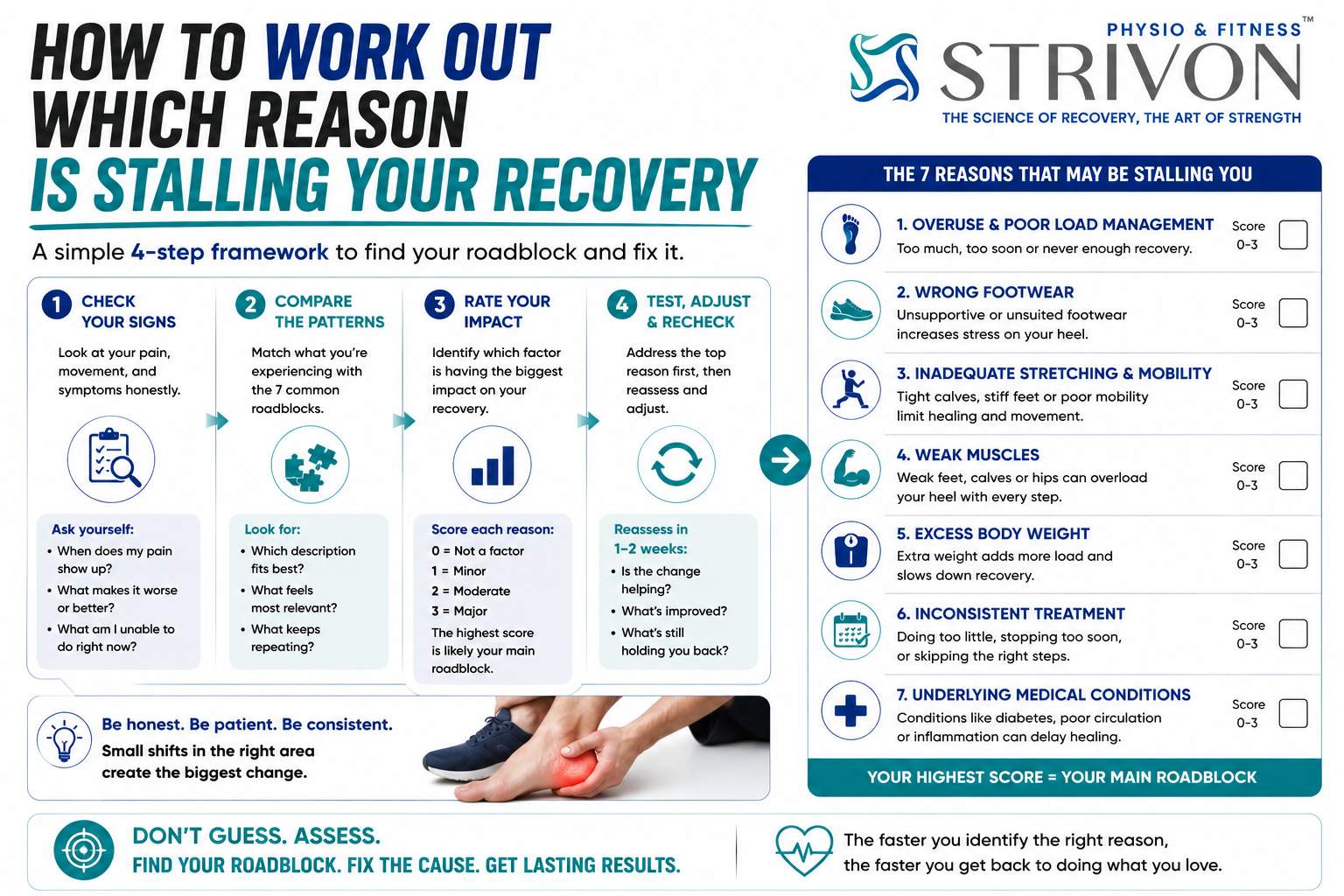
How to work out which reason is stalling your recovery
Finding your reason usually comes down to a few honest questions. Has anyone actually confirmed your diagnosis by examining you, or was “plantar fasciitis” assumed? Did the pain settle with rest and then return the moment you got active — a classic sign that stage-two capacity was never built? Has your rehab ever included heavy, progressive strengthening, or only stretching and massage? Did the pain begin after a clear spike in walking, standing or training? Has anyone looked above your ankle? Are you still chasing passive relief months later? And has your programme actually got harder over time?
Wherever you answer “no” or “that’s me,” you have probably found a reason your chronic heel pain is stuck. Most stalled recoveries involve two or three of these at once — which is exactly why single fixes rarely work, and a joined-up plan so often does.
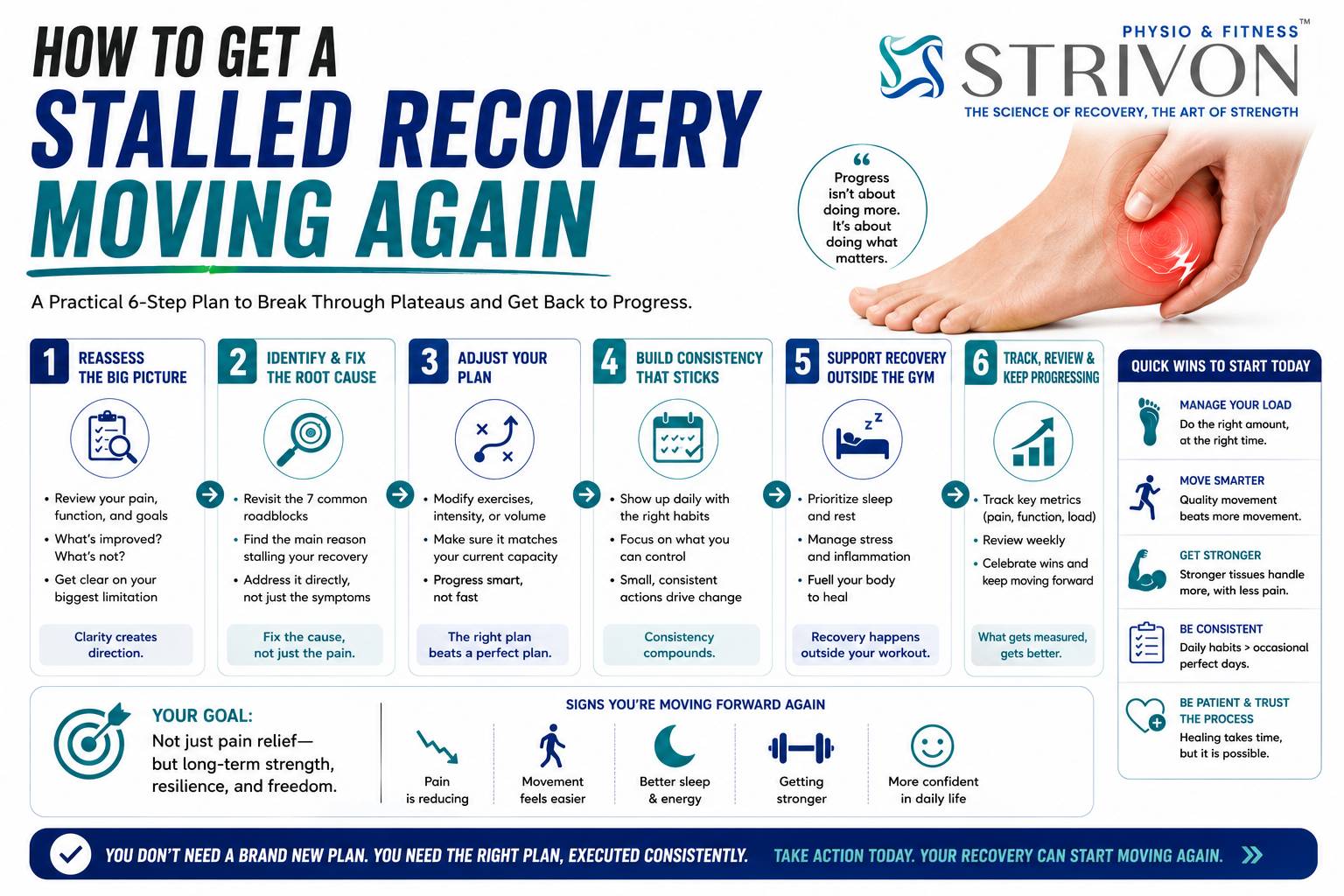
How to get a stalled recovery moving again
Pulling the seven reasons together, most stuck cases of chronic heel pain need the same shift in approach:
- Confirm the diagnosis before chasing more exercises.
- Rebuild capacity — don’t just reduce activity and hope.
- Strengthen the calf and foot for your real demands, with load that progresses.
- Manage load so change is gradual, not sudden.
- Assess the whole lower limb, not only the heel.
- Use passive relief to support active rehab, never to replace it.
- Progress the plan and measure it by function, not just pain.
None of this is exotic — but done together, it is what finally moves chronic heel pain that isolated fixes never could. Your heel pain may not need another random exercise off the internet. It may need a better recovery strategy.
Where to go from here
Persistent heel pain rarely needs one more stretch pulled from a video — it needs a clear, staged plan that moves from calming symptoms to rebuilding real load tolerance.
To understand how that recovery process is meant to unfold, and what to focus on at each stage, the Heel Pain Recovery System guide walks through it step by step.
And if your heel pain has already dragged on for months despite your best efforts, a physiotherapy assessment can confirm what’s actually driving your chronic heel pain, rule out the common look-alikes, and set up a progressive plan built around the activities that matter to you.
FAQ
Most short-lived heel pain settles within a few weeks. Chronic heel pain — pain lasting beyond about three months — typically needs three to six months of progressive rehabilitation to fully resolve, because the tissue has to rebuild strength and load tolerance, not merely calm down. Timelines shorten when the diagnosis is correct and the plan is genuinely progressed.
Plantar fasciitis that won’t go away usually reflects one of the seven issues above — most commonly an unconfirmed diagnosis, or a plan that reduced pain but never rebuilt capacity. If your plantar fasciitis is not going away despite months of stretching and rest, that’s a strong signal it needs progressive loading and, often, a fresh assessment.
Usually both, in the right order. Short-term relative rest can calm an irritated heel, but lasting recovery from chronic heel pain comes from progressively loading the tissue. Complete, prolonged rest tends to lower capacity further, which is exactly why the pain returns the moment you resume activity. Think “settle, then build.”
Often yes, with the load adjusted. Many people can continue some activity if it stays within a tolerable level of pain and settles quickly afterwards. The key is managing the load-versus-capacity gap that drives chronic heel pain — reducing volume or impact temporarily while you build strength, rather than pushing through hard or stopping entirely.
See a physiotherapist if your heel pain has lasted more than a few weeks, keeps returning, is limiting your walking, standing or sport, or hasn’t responded to basic self-care. Early, accurate assessment is the fastest route out of chronic heel pain and can spare you months of stalled recovery.