
ACL Rehabilitation Protocol: A Week-by-Week Guide From Surgery to Sport
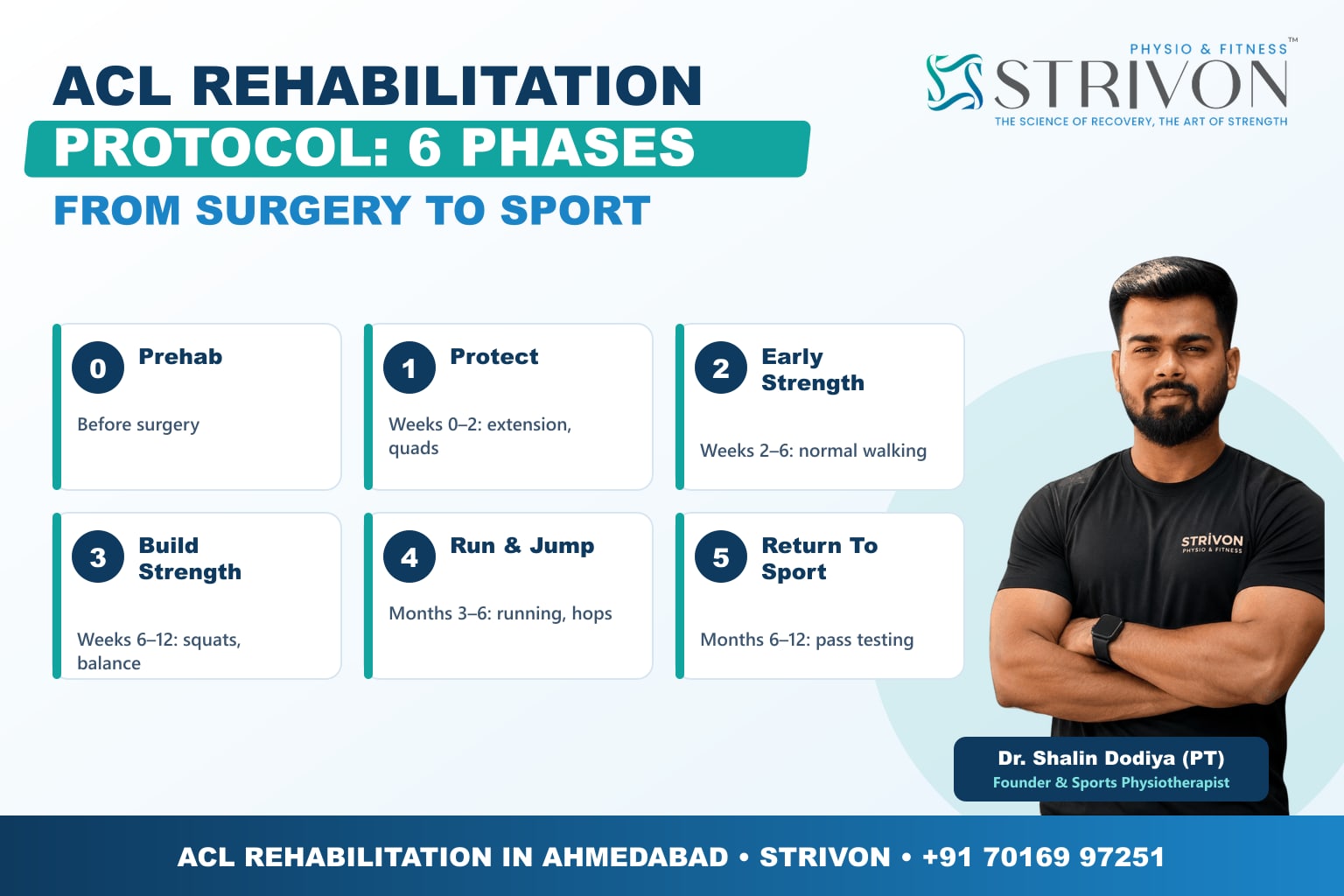
Short answer: a modern ACL rehabilitation protocol has six phases — prehab before surgery, protection (weeks 0–2), early strengthening (weeks 2–6), strength building (weeks 6–12), running and power (months 3–6) and return to sport (months 6–12). Progress should depend on meeting criteria such as full knee extension, no swelling and quadriceps strength within 10% of the other leg — not on dates alone. Most athletes return to cutting and pivoting sports at 9 to 12 months, because returning earlier clearly raises the risk of a second injury.
An ACL reconstruction takes about an hour in the operating theatre. The ACL rehab after surgery takes the better part of a year, and it decides how well you walk, run, play and protect the knee for the rest of your life. This guide explains the ACL rehabilitation protocol we follow at Strivon Physio & Fitness in Ahmedabad — phase by phase, with the exercises and milestones that matter at each stage.
Important: every surgeon’s protocol is slightly different, especially if you had a meniscus repair or another ligament repaired at the same time. Always follow your surgeon’s restrictions; this guide explains the general pathway.
ACL rehabilitation protocol at a glance
| Phase | Typical timing | Main goals | Move on when |
|---|---|---|---|
| 0. Prehab | Before surgery | Swelling down, full extension, quad control | Knee calm, full straightening, good quad contraction |
| 1. Protect & activate | Weeks 0–2 | Control swelling, full extension, quad activation | Straight leg raise without lag, walking with minimal limp |
| 2. Early strength | Weeks 2–6 | Normal walking, bend to 120°, closed-chain strength | Normal gait, no swelling after exercise |
| 3. Build strength | Weeks 6–12 | Strength, balance, full range | Single-leg squat with control, quad strength improving |
| 4. Run & power | Months 3–6 | Running, jumping, landing | Quad strength ≥ 70–80% of other leg, pain-free hopping |
| 5. Return to sport | Months 6–12 | Agility, cutting, sport drills, testing | Pass return-to-sport test battery (≥ 90%) |
Phase 0: Prehab before ACL surgery
Rehab starts before the operation. Research and clinical experience show that people who go into surgery with a calm knee, full extension and good quadriceps control usually recover faster afterwards. Typical prehab goals:
- swelling settled and the knee able to straighten fully
- a strong quad contraction and a straight leg raise without the knee bending
- normal walking and a bend of at least 120°
- a basic strength programme for both legs, hips and core
If you have just torn your ACL and surgery is weeks away, this is the best time to see a physiotherapist.
Phase 1: Weeks 0–2 after ACL surgery — protect and activate
The goals of the first two weeks are simple but critical: control swelling, get the knee fully straight, and switch the quadriceps back on.
- Swelling: ice, compression and leg elevation several times a day.
- Full extension: heel props and lying with the knee straight. Losing extension early is one of the hardest problems to fix later.
- Quad activation: quad sets and straight leg raises many times a day.
- Bend: gentle heel slides, usually aiming for about 90° by the end of week 2.
- Walking: with crutches and a brace as your surgeon advises, weaning off as your walking pattern normalises.
Phase 2: Weeks 2–6 — early strengthening and normal walking
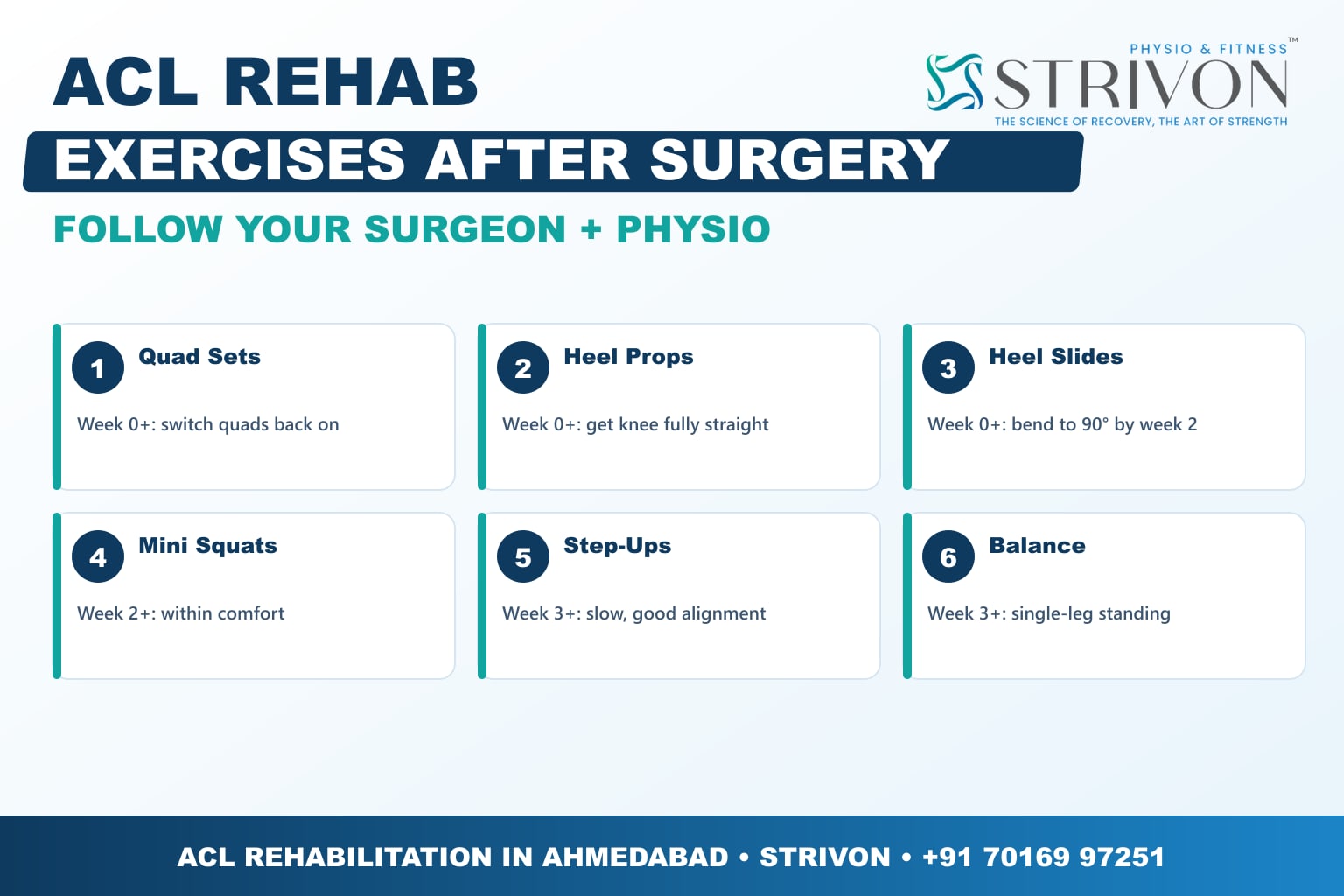
Once the knee is calm and fully straight, the focus moves to walking normally and building early strength. These ACL rehab exercises are typical for this phase:
- Mini squats and wall sits within a comfortable range.
- Step-ups onto a low step, slowly and with good knee alignment.
- Glute bridges and hamstring curls with light resistance, if your graft allows it.
- Calf raises on both legs, then one leg.
- Stationary cycling once you can bend about 110–115°.
- Balance work: single-leg standing, first on the floor, then on a cushion.
Swelling is your guide. If the knee is more swollen the next morning, the previous day’s load was too much.
Phase 3: Weeks 6–12 — build real strength
This is where ACL rehab after surgery often goes wrong: pain has settled, walking feels normal, and many people stop coming or keep doing the same easy exercises. But the quadriceps on the operated side is usually still much weaker than the other leg.
In a good ACL rehabilitation protocol, phase 3 is about progressive, heavier strength training:
- leg press and squats with increasing load
- split squats, lunges and step-downs
- Romanian deadlifts and hamstring strengthening
- single-leg balance with reaching and catching
- continued cycling or swimming for fitness (check with your surgeon before swimming kicks)
We measure strength regularly so decisions are based on numbers, not on how the knee feels on one day.
Phase 4: Months 3–6 — running, jumping and landing
In our ACL rehabilitation protocol, running usually starts around 3 to 4 months, but only when you meet the criteria — typically no swelling, full range, pain-free single-leg squats and quadriceps strength of at least 70–80% of the other leg. Running too early on a weak quad is a common reason for knee pain and setbacks.
This phase introduces:
- a walk–run programme on flat ground
- two-leg jumps and landings, progressing to single-leg hops
- deceleration drills — learning to stop safely
- continued heavy strength work two to three times a week
Phase 5: Months 6–12 — return to sport
The final phase rebuilds everything your sport demands: cutting, pivoting, sprinting, contact and reacting to other players. Drills become faster, less predictable and more sport-specific — cricket, football, badminton, kabaddi or basketball each need a slightly different plan.
Return to full sport is a decision, not a date. Before clearing an athlete, we test:
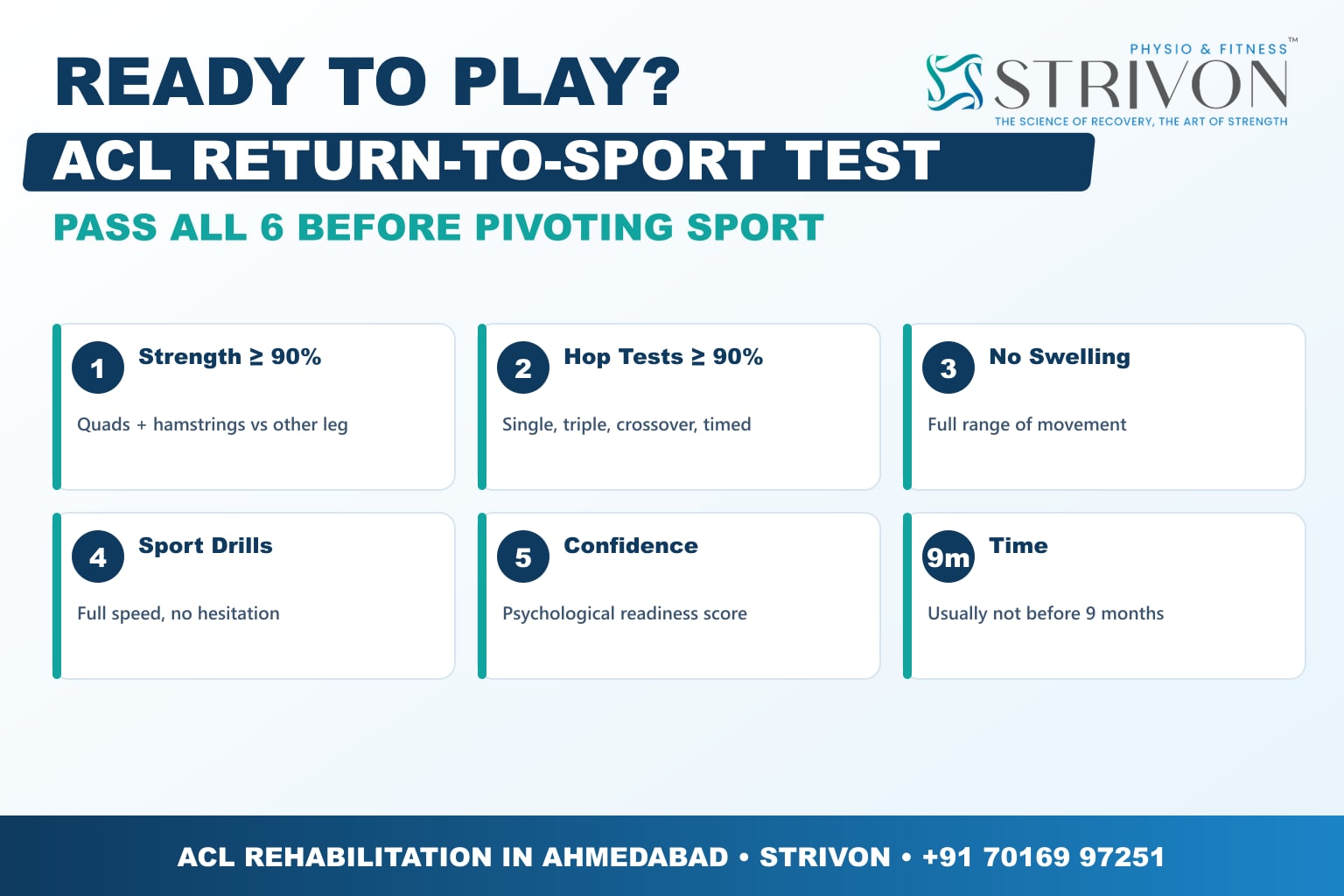
- Quadriceps and hamstring strength: at least 90% of the other leg
- Hop tests: single hop, triple hop, crossover hop and timed hop at 90% or more of the other leg
- No swelling and full range of movement
- Sport-specific drills completed at full speed without hesitation
- Psychological readiness: confidence in the knee, often measured with a questionnaire
Research following athletes after ACL reconstruction has shown that returning to pivoting sport before 9 months, and without meeting strength and hop criteria, is linked to a much higher risk of re-injury. That is why we rarely clear pivoting athletes before 9 months, even when they feel ready earlier.
ACL surgery recovery time: realistic milestones
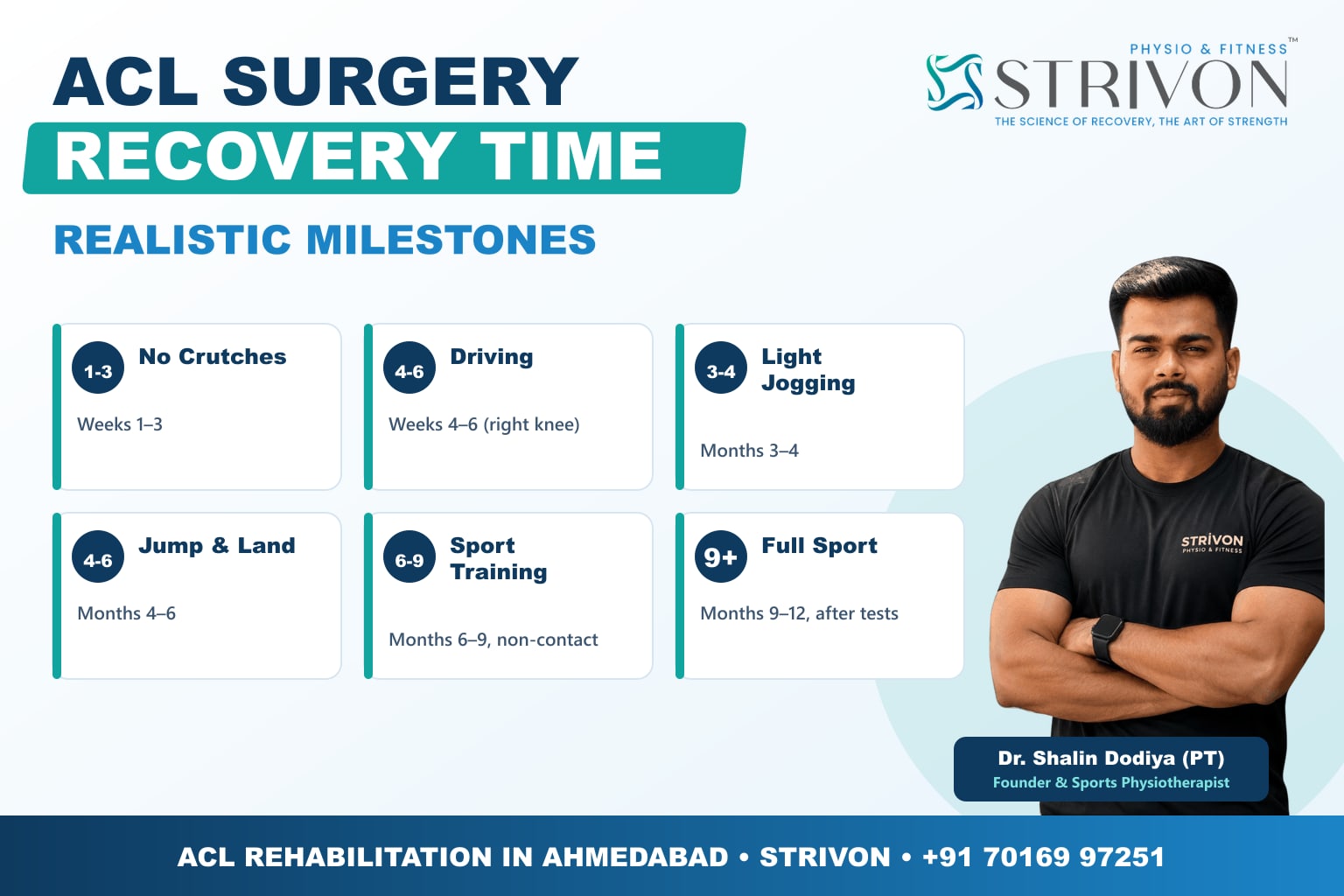
ACL surgery recovery time depends on your surgery, your starting strength and how consistently you train. These are typical milestones for a well-managed recovery:
| Milestone | Typical time after surgery |
|---|---|
| Walking without crutches | 1–3 weeks |
| Back to desk work | 1–3 weeks |
| Driving (right knee) | 4–6 weeks, when you can brake safely |
| Stationary cycling | 2–4 weeks |
| Light jogging | 3–4 months |
| Jumping and landing drills | 4–6 months |
| Non-contact sport training | 6–9 months |
| Full cutting/pivoting sport | 9–12 months |
Common mistakes in an ACL rehabilitation protocol
- Not getting full extension early. A knee that will not straighten fully causes a limp, knee pain and weak quads.
- Stopping rehab when walking feels normal. Around 2–3 months is when strength training matters most.
- Following dates instead of criteria. Running at 12 weeks is fine only if your strength and swelling allow it.
- Ignoring the other leg, hips and trunk. Poor hip control is a common factor in ACL injuries in the first place.
- Skipping return-to-sport testing. Feeling ready is not the same as being ready.
ACL rehabilitation in Ahmedabad at Strivon
We manage ACL rehab after surgery from the first post-operative week to final return-to-sport testing, and we also help people who choose to rehabilitate without surgery. ACL rehabilitation in Ahmedabad at Strivon includes:
- a written, criteria-based ACL rehabilitation protocol that follows your surgeon’s instructions
- supervised strength training on our rehab floor from the early weeks
- aqua therapy for early pain-free loading
- objective performance testing before return to sport
- physiotherapy at home for the first weeks if travel is difficult
Read more about our sports injury rehabilitation in Ahmedabad, or about knee pain physiotherapy if your knee still hurts after surgery. For costs, see our guide to physiotherapy cost in Ahmedabad.
Frequently Asked Questions
Most ACL rehabilitation protocols last 9 to 12 months for athletes returning to cutting and pivoting sports. You can usually walk without crutches in 1 to 3 weeks and start jogging at 3 to 4 months, but full return to sport takes longer.
Most people walk without crutches within 1 to 3 weeks and walk without a limp by about 4 to 6 weeks, provided swelling is controlled and the knee straightens fully. A meniscus repair may delay full weight-bearing, so follow your surgeon’s advice.
Early on: quad sets, straight leg raises, heel slides and heel props for full extension. Later: squats, leg press, step-ups, split squats, hamstring strengthening, balance work, and eventually hopping, landing and agility drills.
Usually around 3 to 4 months, once you have no swelling, full range of movement, pain-free single-leg squats and quadriceps strength of at least 70 to 80 percent of the other leg.
Returning to cutting and pivoting sport at 6 months is generally too early. Research links return before 9 months, and without passing strength and hop tests, to a higher risk of re-injury. Non-contact training can often start between 6 and 9 months.
A torn ACL does not usually heal back to its original form, but some people — especially those who do not play pivoting sports — function very well with structured rehabilitation and no surgery. The decision should be made with your orthopaedic surgeon and physiotherapist.